Archive | Human Rights RSS feed for this section

Debating Ahmadinejad at Columbia

25 Sep
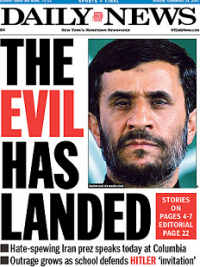
The New York Daily News cover when Iranian President Mahmoud Ahmadinejad came to New York in 2007

The New York Daily News cover when Iranian President Mahmoud Ahmadinejad came to New York in 2007

A TALL man with white hair, wearing a US-flag print shirt and pants, patrolled the sidewalk at 116th and Broadway. He waved a huge American flag as he marched, in movements that were nearly metronomic in their consistency. Stacks of brochures sat on a bare and rickety table, waiting to be handed out to anyone who didn’t look away quickly enough. Bystanders stared.

I hadn’t been back to my former school almost since I graduated. Returning as an alumna of the School of International and Public Affairs (SIPA), the school that sponsored Iranian President Mahmoud Ahmadinejad’s talk here on Monday, I felt the puff of pride that Columbia had not backed down in the face of media pressure. I also felt just a little bit cheated that it was happening now, when I was attending as an outsider, rather than the first time his talk had been announced, in 2006, when I was still a sleep-deprived student.

Continue reading

Communique Editorial Vol. 16 No. 5

11 Dec
Congressman Keith Ellison from Minneapolis, the first Muslim ever elected to U.S. Congress

Congressman Keith Ellison from Minneapolis, the first Muslim ever elected to U.S. Congress

SIX Muslim religious leaders were escorted off a U.S. Airways plane on November 20 because a fellow passenger—who saw three of them conducting their daily evening prayer—thought they looked “suspicious.” So suspicious, in fact, that after having been removed from their plane to Phoenix, and returning to the airport the next day to catch another flight, the airline ticket agent told them their money had been refunded and that the airline would not sell them any more tickets.

Last July in London, police officers shot a Brazilian in the head six times, and once in the shoulder, suspecting him of being a suicide bomber. They were in the Stockwell Tube Station—a place where immigration checks had been stepped up—and when the police challenged him, he jumped over the turnstiles and ran. His visa status was uncertain, home ministry officials said at the time, and he was apparently afraid of being deported.

More recently, an American citizen of Iranian descent, 23-year-old college senior Mostafa Tabatabainejad, was tasered repeatedly in a UCLA library computer lab by campus police. Asked to show ID, he refused, believing he had been singled out because of his Middle Eastern appearance. He finally agreed to leave, but was nonetheless tasered five times. The campus police continued delivering the nerve-stunning electric shocks, even after putting Tabatabainejad in handcuffs.

There are several issues at play in these incidents: police brutality, the legitimization of force, an atmosphere of fear, racial profiling and, most importantly, the “war on terror.”

Many of these issues have existed since before Bush’s Orwellian-named war. But this war has also bred a culture of fear in which those in authority feel justified in singling out people who look or act differently than them, especially Muslims; shooting first and thinking later; and continuing their behavior, partly because they are not punished for their actions.

Anti-Muslim racism—which goes beyond racial profiling but includes it—is not limited to immigrants and ordinary people. Keith Ellison, the Minneapolis congressman and the first Muslim ever elected to Congress, was interviewed by the notoriously inflammatory CNN host Glenn Beck, who asked his guest to “prove to me that you are not working with our enemies.”

On previous shows, Beck distinguished between “good” and “bad” Muslims, calling for good Muslims to shoot bad Muslims in the head, and warning that “Muslims will see the West through razor wire [referring to concentration camps] if things don’t change.”

The war on terror has become an excuse for the Bush administration and its partners to bomb populations and illegally invade countries. Like a schoolyard bully, the United States refuses to abide by world rules and rewrites history when convenient.

No wonder, then, that authorities (such as the police) in the countries conducting the war on terror follow their leaders’ example in declaring their own form of war against anyone who looks or acts “suspicious,” especially anyone who might be Muslim.

The world needs to show trigger-happy police officers and war-waging presidents that their actions have consequences, and that they will have to face them. And the media—instead of printing police press releases and ignoring student eye-witness statements; instead of questioning the loyalty of democratically-elected leaders just because they’re Muslims—need to be at the frontline of this fight.

This editorial was printed in the fifth edition(PDF) of the student newspaper of the School of International and Public Affairs, Communiqué, where I was editor-in-chief, in the fall of 2006.

Communique Editorial Vol. 16 No. 4

28 Nov
Former U.S. Secretary of Defense Donald Rumsfeld

Former U.S. Secretary of Defense Donald Rumsfeld

THE recent war crimes charges filed in Germany against former U.S. Defense Secretary Donald Rumsfeld and his cronies are long overdue. Rumsfeld, the public face of the Iraq war, is also largely responsible for the war’s less publicized side: human rights violations and torture.

The suit alleges Rumsfeld’s responsibility for “several dozen individual cases of prisoner maltreatment” and nearly 100 detainee deaths. It is being brought by U.S. and international human rights organizations—among them the Center for Constitutional Rights, the National Lawyers Guild, the International Federation for Human Rights, and the German Republican Attorneys’ Association. The suit invokes Germany’s universal jurisdiction law, which allows the prosecution of war crimes no matter where they were committed.

Under the War Crimes Act of 1996 and the Anti-Torture Act of 1996, a “war crime” is any “grave breach” of common Article 3 of the Geneva Conventions, which prohibits “outrages upon personal dignity, in particular, humiliating and degrading treatment,” as well as torture and murder.

One of the suit’s many allegations is that Rumsfeld personally ordered harsher torture methods against Mohamed al-Qahtani, the alleged “20th hijacker” of September 11, when al-Qahtani didn’t confess to terrorist activities during initial interrogations. According to the 2005 congressional hearings on the case, Al-Qahtani was stripped, made to wear women’s underwear on his head, denied access to the bathroom, threatened with dogs, and deprived of sleep over a six-week period. The records also say he was kept in solitary confinement for 160 days and questioned for 18 to 20 hours per day.

In a December 2002 directive, Rumsfeld also authorized a list of torture techniques for use against terror suspects. This list included hooding, stripping, isolation, seizure of all religious items, deprivation of light and auditory stimuli, and the use of phobias to induce stress.

Rumsfeld also authorized the use of waterboarding, a form of torture in which the prisoner is strapped to an inclined board while interrogators run water over his mouth and nostrils to induce the sensation of imminent death by drowning.

Furthermore, the former Defense Secretary has admitted to ordering a prisoner’s presence to be kept from prison rolls and hidden from the Red Cross for at least seven months—a violation of the Geneva Convention, which requires that all countries grant Red Cross access to detainees regardless of where they are being held.

The suit also cites orders to commit torture, or failures to prevent it, by U.S. Attorney General Alberto Gonzales, former CIA director George Tenet, and recently retired U.S. Army Lieutenant General Ricardo Sanchez, the former commander of U.S. forces in Iraq.

The case against Rumsfeld and his cronies is clear and compelling. German prosecutors declined to prosecute a similar, though more limited, suit in 2004. Then, Rumsfeld was protected by general diplomatic immunity. Today, stripped of his title, his flank is exposed.

The German courts must uphold the rule of law and rule that Rumsfeld and company have committed war crimes, showing the world that the Bush administration cannot callously discard the human rights it claims to uphold.

This editorial was printed in the fourth edition(PDF) of the student newspaper of the School of International and Public Affairs, Communiqué, where I was editor-in-chief, in the spring of 2006.

Communique Editorial Vol. 16 No. 2

23 Oct
Lynne Stewart

Lynne Stewart

IT’S not just terrorism that the United States is at war with—it’s civil liberties. The Military Commission Act of 2006, which George W. Bush signed into law on September 29, establishes a new system of military tribunals to try terrorism suspects. The MCA also bars non-U.S. citizens from challenging their detention in federal courts.

The law formalizes what has been happening in practice since the “war on terror” began: the suspension of habeus corpus, a right the country’s founding fathers deemed important enough to protect in the U.S. Constitution.

A judicial mandate, the writ of habeus corpus orders that a prisoner be brought to court to determine whether he or she has been lawfully put away. In 1798, Thomas Jefferson—who insisted on including habeus corpus in the Constitution—wrote, “The Habeas Corpus secures every man here, alien or citizen.”

The MCA seeks to take away the “great writ,” as it is often called, from anyone the Bush administration claims is an “enemy combatant.”

The definition of an enemy combatant includes not just members of Al-Qaeda, but also lawful permanent residents and American citizens, if Bush so chooses. It can be anyone who “has purposefully and materially supported hostilities against the United States.”

And that’s not the only way that the Bush administration is intimidating those who stand in its way. The recent sentencing hearing of defense lawyer Lynne Stewart brought another victim of the United States’ war on terror into the spotlight. Stewart, a member of the court-appointed defense team for Sheik Abdel Rahman, who is serving a life sentence in connection with the 1993 World Trade Center bombing, was charged under the 1996 Terrorism Act with four counts of aiding and abetting terrorism.

Her crime? She violated an agreement not to transmit messages from her client to unauthorized people. In June 2000, after meeting Rahman, she called Reuters to discuss his stance on the Egyptian cease-fire.

Stewart did violate an agreement she signed. But her punishment should be proportionate to her action. Violation of the agreement constitutes a civil, not a criminal, offense. So to be hauled in for aiding and abetting terrorism smacks of intimidation in the legal process, something the Bush administration has not been shy about doing.

The New York Times, in its reportage about a private meeting of high-level officials in 2003 on the military commission structure, quoted then-Attorney-General John Ashcroft as saying, “Timothy McVeigh was one of the worst killers in U.S. history. But at least we had fair procedures for him.”

These fair procedures are now fading away, thanks to George W. Bush. In the Hamdan case, Justice Kennedy said, “The Constitution is best preserved by reliance on standards tested over time and insulated from the pressures of the moment.” The pressures of this moment are ensuring that these standards are being systematically weakened and that the war on terrorism is turning into a war on civil liberties.

This editorial was printed in the second edition(PDF) of the student newspaper of the School of International and Public Affairs, Communiqué, where I was editor-in-chief, in the fall of 2006.

Communique Editorial Vol. 15 Issue 4

3 Apr

EVERY country has an underclass of workers to do the jobs no one else wants: France has its Muslim ghetto population; India has its untouchables; the United States has illegal immigrants.

It’s a symbiotic but unequal relationship. Undocumented immigrants need income, and the economies of these countries would be debilitated without cheap manual labor. So they continue in an exploitative partnership, now under further attack by Rep. Jim Sensenbrenner’s anti-immigration bill.

Last December, Sensenbrenner convinced the House of Representatives to pass the “Border Protection, Antiterrorism, and Illegal Immigration Control Act of 2005” (H.R. 4437). Under this act, undocumented immigrants would become felons. The bill, now under consideration in the Senate, also seeks to erect 700 miles of fencing along the Mexican border, limit immigrants’ access to circuit courts, make undocumented immigration status a criminal (not a civil) offense, expand mandatory detention policies and more.

This means that if you, as a foreign student, let your course load drop below the required credits, you will be considered a criminal.

The bill will result in the detention of an astounding number of immigrants. Many will be subject to deportation; those whose home countries refuse them will be subject to indefinite detainment. The Department of Homeland Security’s plans to build $385 million worth of immigrant detention centers (contracted to Halliburton subsidiary Kellogg Brown Root) is hardly a productive response.

U.S. immigration rates are higher than ever. But militarizing the Mexican border and criminalizing immigrants is not the answer xenophobic lawmakers think it is. People will continue to filter through the borders, albeit at higher personal cost. They are already aware that they could be deported, even killed, in the process. Many sell themselves into years of sweatshop labor to repay those who brought them here. They are not likely to stop their dangerous journeys with these changed stakes. The situations in their countries of origin are still just as desperate.

Sweatshops will continue to operate in cities like New York and Los Angeles, 500,000-strong protest rallies will continue to be underreported, and the country’s 12 million undocumented immigrants will continue to live lives of quiet desperation. This legislation will merely force them to gamble more heavily, lose more if caught and live far more miserable lives while on U.S. soil.

This editorial was printed in the fourth edition(PDF) of the student newspaper of the School of International and Public Affairs, Communiqué, where I was editor-in-chief, in the spring of 2006.